
3 ways to target abandoned cart recovery emails

When we decided to implement a program of Email marketing for abandoned cart recovery (abandoned cart emails), It is important to have information about the main reasons for abandonments. There are several studies that collect this data. One of the most recent and comprehensive is the one conducted by the Baymard Institute whose results You can see them in this link along with other relevant information.
Looking at the 6 main reasons declared by the users, we have seen that they exist. Three major categories or reasons for abandonment.
First and foremost, and most notably, there is the motivation linked to cost. 61% of the respondents claim to have abandoned the check-out process due to extra costs. Second, there are four reasons that we could categorize under the category of «time demand.» These are situations where the user decides to abandon the process because they have to invest more time than they would like. Under this criterion, we have included the following reasons:
«I was asked to create an account»
«The check out process is too long/complicated.
«I couldn't see/calculate the final cost of the order I started»
«The site didn't work properly»
In each of these motives, the user is implicitly conveying that they decided not to «spend more time» until the process was complete (creating an account, being patient…).
Finally, a third reason has to do with the trust generated by the site. As a result, 18% of users claim that they abandoned a checkout process precisely because they did not trust leaving their card number.
Assuming the validity of this interpretation, we propose to give the recovery emails for the shopping cart, three different directions depending on the reason why our users abandon the purchase process. We illustrate this below with the following examples:
- Email addressed to users who left due to the price.
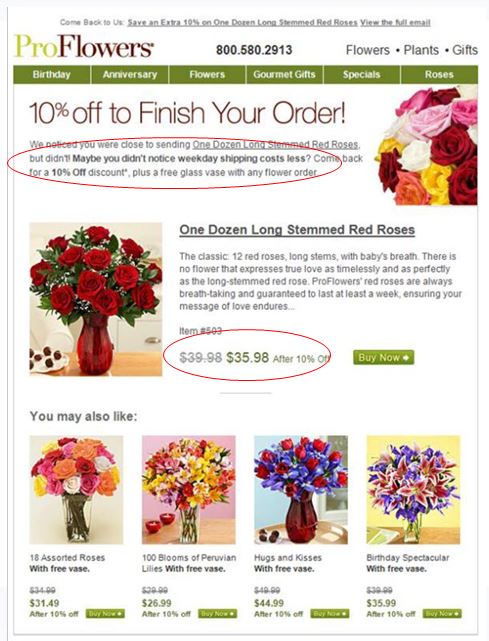
In this example from Flowers, the cart recovery email emphasizes that from Monday to Friday shipping costs are 10% off. Additionally, the user is encouraged to complete the purchase with the gift of a crystal vase. Let’s note that the way the price is presented is by comparing the before and after.
2.Email directed to «impatient» users.

In this case, no discounts or incentives are offered. Although only the items with their price are clearly displayed, we see that recourse is made to beginning of aversion to loss to convey urgency to the user.
Those users who receive the email and who abandoned the purchase process due to lack of time now have the opportunity to complete it, with the added incentive of avoiding losing the items they are interested in.
3. Email directed to users who were suspicious.
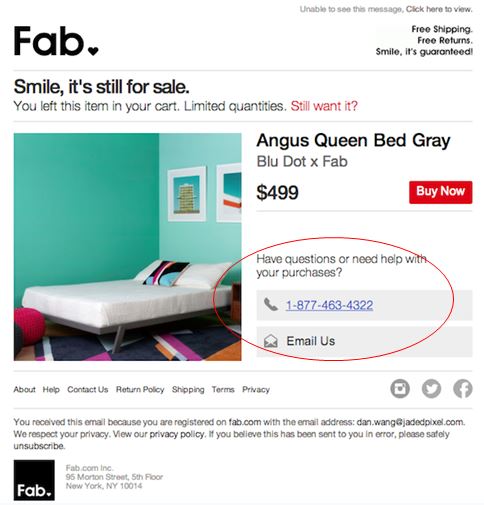
The distrust that a website can convey can be mitigated by making available to the user warmer and more personal contact lines. The idea is that the user can express their doubts and concerns so that a real person can address them with attention and professionalism. This is what we see in the example of Fab. The user has abandoned the purchase process of a product whose price is considerable. Thus, the email highlights the existence of two ways to contact the support center directly, by phone and by email. An email of this type seeks to overcome the resistance that caused the user to abandon the initial purchase process.
We have mentioned three different directions we can take for abandoned cart recovery emails. Unless it is very obvious, it is likely that we do not know which of the three factors (lack of time, excessive price, or distrust) best explains why users abandon the checkout process. In this situation, It is advisable to test the three types of emails in parallel, so that we can identify which one converts the most.
