
Are you implementing these advanced email and marketing automation strategies?

Having a complete and effective email marketing strategy is not an easy task. In fact, there are few brands and companies that have implemented all the email marketing strategies we will discuss today, which will ensure an increase in conversions and user engagement. Take note!
1- Predictive activation campaigns
This type of campaigns starts from recognition of a pattern of previous behavior (historical) and the identification of current users with behavior analogous to that pattern. If we find users whose current behavior resembles that of the pattern, we can predict behaviors similar to that pattern, which means that we already have a criteria for defining a marketing action, In this case, the sending of a specific email. For example, we could define that an automated email is sent to users who, after 90 days of subscription, have not yet made a transaction. Every time the pattern is met, the stipulated email will be sent automatically.
2- Abandoning navigation
This strategy consists of sending an email to those users who have active product search behavior in the e-commerce but who have not completed a transaction. The goal is for the user to remember the products they were looking at again, in order to convert them into a customer.
3- Abandoned Cart
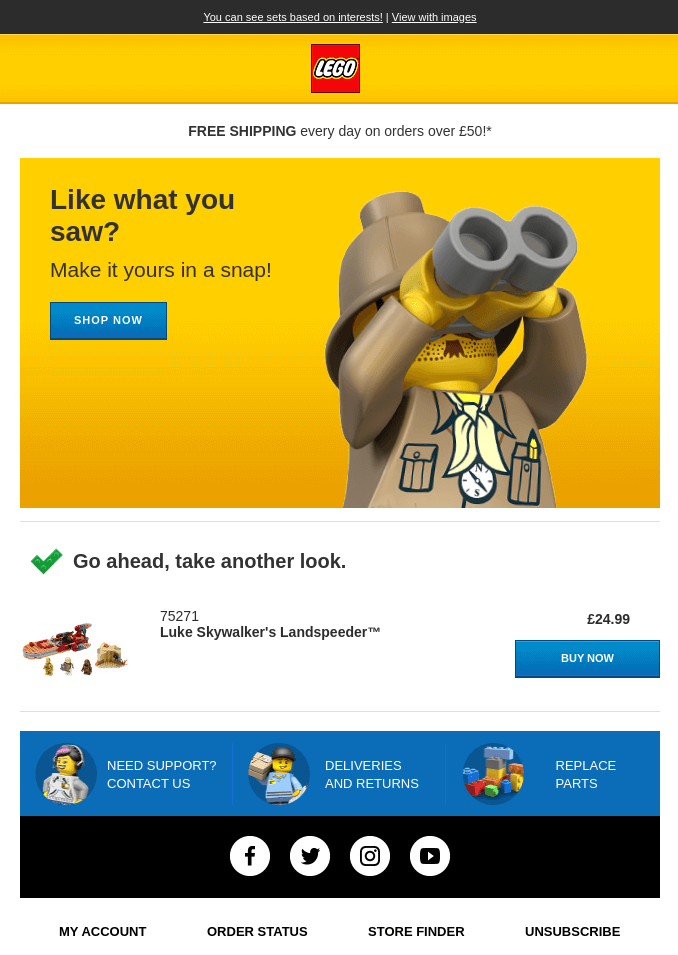
A program of this nature aims to recover abandoned shopping carts during the checkout process in e-commerce. It is important to take into account the high rate of abandoned shopping cart abandonment in e-commerce, which can range from 55% to 80 percent depending on the source. A good abandoned cart recovery program It can mean recovering between 15% and 25% of the abandoned carts. These figures make it one of the most effective email marketing strategies.
Here is an example of Lego:
4- Welcome series for first-time buyers
This tactic consists of sending a welcome email to the user who has purchased for the first time or who has exceeded a certain spending threshold. This will help strengthen engagement and convert the newly acquired customer into a loyal and repeat buyer.
5- Loyalty campaigns
A loyalty program It is structured around a classification of customers into segments based on a combination of their current and potential value.
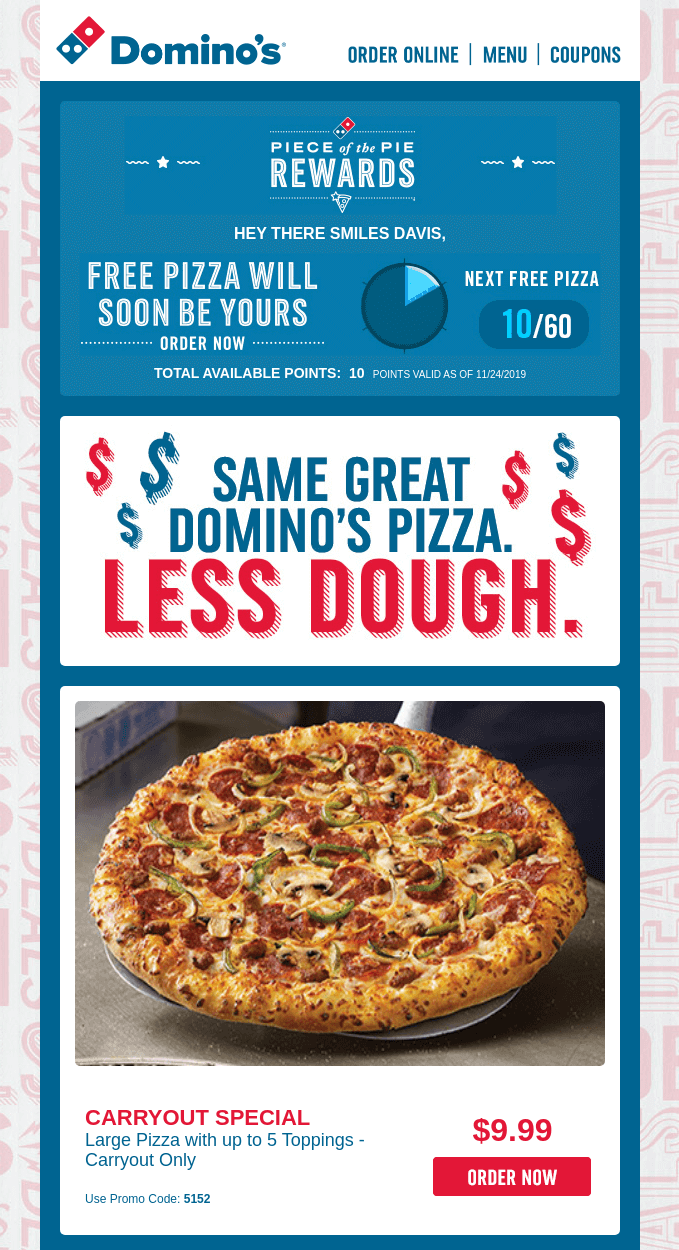
The dynamic of loyalty programs is to update the potential value of customers and to retain users who are providing more value. In short, it is about managing the customer relationship so that its maximum value is maximized. Lifetime Value. Here we leave you as an example, the header of an email from Domino’s Pizza, where the user is warned that they may soon enjoy a free pizza.
6- Product replenishment campaigns
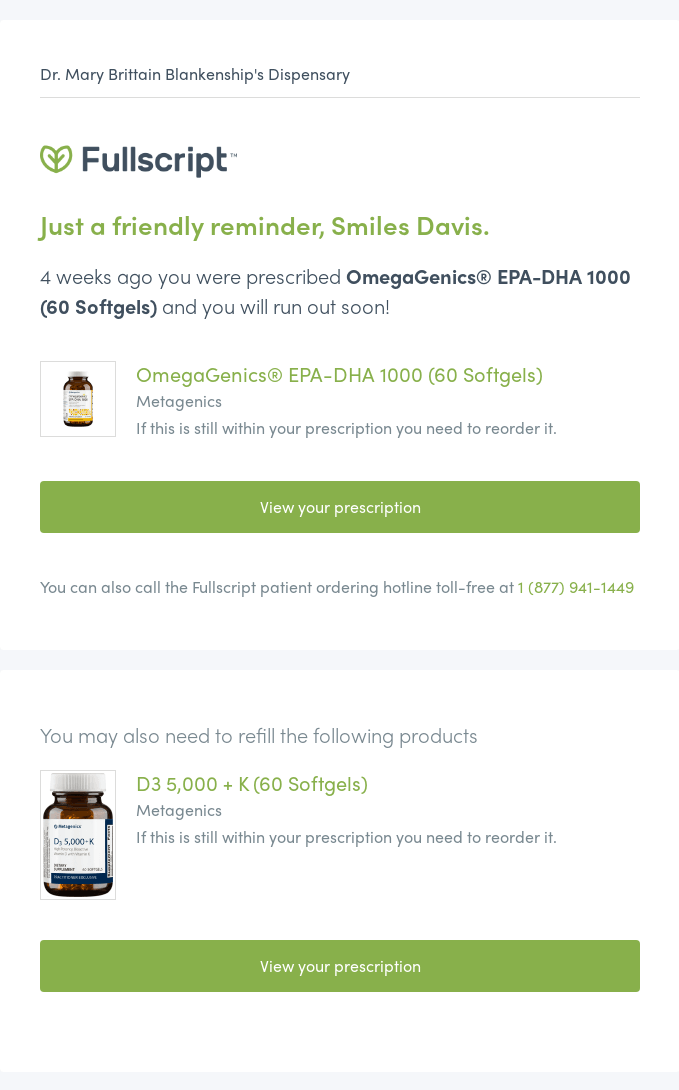
The product replenishment tactics or replenishment, They consist of anticipating the moment when our client will need our product again.
Knowing the product's lifecycle and the volume and date on which a particular customer placed an order, we can estimate when they will need to place another order to send them an email. Here is a part of an email from Fullscript As an example:
7- Campaigns to explain the use of a purchased product/service
These types of tactics are aimed at complementing the recent acquisition of a product or service by our client. They are about using the email channel to help the client get the most out of their recent purchase with the aim of improving their experience as a user of our brand. Below you can see a good example of the cosmetics brand Iliawhere they explain how to apply the purchased product correctly.

