
3 Email Best Practices you should reconsider: Remove inactive users
"I have never seen a mailing list where the 10% of users (which we consider the most active) generate more monetary value than the other 90% as a whole".
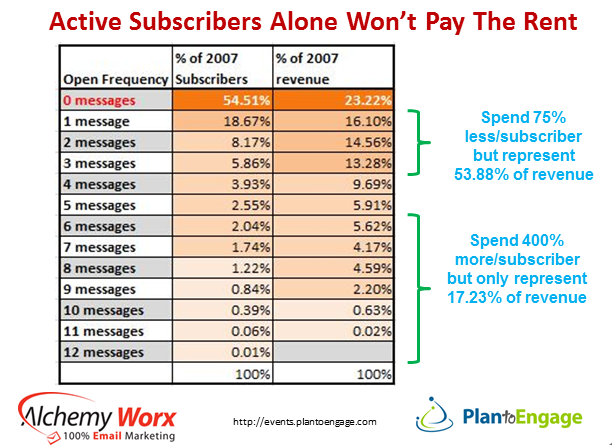
In this table we observe that, the The sum of the total ROI obtained with the least active users is greater than the small group of most active users. This is the argument that Quist uses to warn us about deleting inactive users. He is quite right in claiming that Engagement cannot be established with an email that is not sent, And therefore, even if the user is not showing interest, every email they receive generates a possibility.
At Digital Response, we think that Dela Quist is right in many of his claims, but we also think that both Quist’s response and the original claim should be nuanced in each case. That is, it is positive to rethink these strategies, but we should not always apply the ideas that Quist brings, as their effectiveness will depend on the case at hand. The strategy to follow depends on the client we are dealing with, the type of audience, and the behavior we can test.r in each specific campaign.
Based on Quist's reflections and adding our own perspective, these are the conclusions:
– It is important to test, first of all to know what the Purpose of the test and usefulness of the results, And don't let us be absorbed by the opening data without taking into account the actual conversion.
– Tests take some time. to provide relevant data.
– Rates and percentages are important for certain analyses, but Don't forget the real numbers.
– Try to reactivating inactive users before making the decision to eliminate them.
– The size of the list matters, but take care of your reputation. It combines an outreach strategy (reaching the largest number of users) with strategies to maintain the reputation of your shipments (such as those we saw in the previous article).
What do you think of Quist's ideas? What is your experience with managing inactive users?
