
Practical case of attribution of conversions in Email Marketing
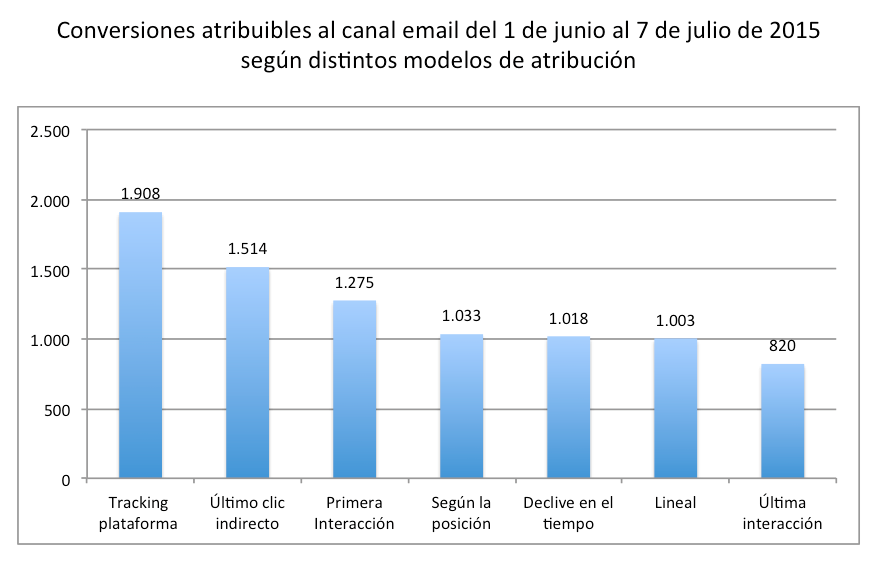
In this post, we will show, through a real case, how different the results (in conversions) attributable to the email channel can be depending on the attribution model we use. To illustrate this, we have taken as a reference the conversions in the period from June 1st to July 7th as shown by Google Analytics and ESP.
LAST INTERACTION
According to this model there were 820 conversions That occurred after clicking on the email. In other words, there were 820 users who converted directly from the email without any other channel intervening until the conversion.
The advantage of a model like this is that it gives us a very accurate view of the conversions attributable to the email, without a doubt, however, it is true that it is not overly restrictive as we will see in the following models.

FIRST INTERACTION
Another distinct perspective is that of considering the weight that the receipt of an email, the reading of the subject line, its opening, and the click have throughout the user’s customer journey. In other words, does the user’s interaction with the email influence them in such a way that it (to a greater or lesser extent) conditions an eventual purchase process? It is reasonable to think that it does. For example, it may happen that the user who has received an email reads the subject line and for whatever reason does not open it. If we have been able to convey valuable information, for example the start of the discounts, it is likely that he will «directly» go to the e-commerce when he is able to browse; or he may see an advertisement for our brand and, conditioned by the email he received previously, decide to interact with this advertisement. In cases like this, it is evident that the email can affect other interactions that culminate in a conversion (we understand that the «push» nature of the email works well with behaviors like the one we have just described). Models of this type are called «first interaction» models, since 100% of the conversion value is attributed to the first channel with which the customer has interacted. According to the example we are discussing, we would find that there has been 1,275 conversions This model does not assign any weight to the email when it is in an intermediate point in the customer journey.

LINEAR MODEL
In the linear model, the same percentage is attributed to the different channels that have intervened in the path to conversion. For example, if a user has interacted with a banner and visited the site but has not converted, after two days they receive an email and access the site again through it without converting, and three days later they search for the brand on Google, access the site, and convert, according to this model the banner, the email, and Google will split the sale in the same proportion (one third each). According to this model, there was 1,003 conversionsThey are attributable to the email.

WEAKENING OF TIME
Google explains that in this model «…it is based on the concept of exponential deterioration and primarily values the closest contact points at the time of conversion. By default, the Deterioration time model has a half-value duration of seven days; that is, the contact point that occurs seven days before a conversion receives half the value of that which occurs on the same day of the conversion. Similarly, the contact point that occurs 14 days before receives a quarter of the value of that which occurs on the day of the conversion. Exponential deterioration extends over the time window, whose predetermined value is 30 days». That is, the email will have a greater weight in conversions the closer it was to the moment of conversion. According to this model, there was 1,018 conversions.

ACCORDING TO THE POSITION
This model combines the first and last interactions. Instead of attributing conversions to the email based on whether it was in the first or last interaction, it is distributed between both. A common example is to assign 40% of the credit to the first and last interactions, and 20% to the intermediate interactions. According to this model, the email was attributed 1,033 conversions.

LAST INDIRECT CLICK
In this case, conversions that come from direct traffic are not attributed to direct traffic, but to the last indirect interaction. For example, suppose a user accesses the site after interacting with an email but does not convert. Two days later, they access the site directly and make a purchase. This model will attribute the conversion to the email because it is the last «indirect» click. According to this model, the conversions attributable to the email were 1.514
If we compare the conversions according to the last interaction with those of the last indirect click, we find that in the second model they are almost double (820 vs 1,514). The interpretation we make from these data is that email serves as a very valid channel for communicating (creating branding).

TRACKING THE ESP
The most common situation is that ESPs have a tracking system based on cookies through which conversions are assigned to a campaign when they occur within the 30 days following. This includes all variants, from users who have clicked on the email and purchased, to others who have clicked but converted days later after accessing the site directly or indirectly through some other channel.
It is not surprising that it is in this system that the highest number of conversions occur, specifically 1.908.
We consider that the models based on the the last direct click and the first interaction They are quite balanced. Assigning all the conversions that the email has participated in, whether directly or indirectly, as ESPs do can be excessive (due to excess), while the last interaction does not include any real impact that the email has throughout the conversion path. Which model do you consider better?
