
Customizing the subject in Email Marketing: results of an A/B test
At another post We have written about the importance of personalizing the subject line of emails with the user's name. Here, we emphasize this idea, although we bring the results of a series of A/B tests of subject lines conducted in France, Portugal, the UK, the USA and Mexico. The question we asked ourselves before conducting this test was whether the effect of personalizing the subject line would have the same impact in different markets. Are there markets where personalization will yield better results than in others?
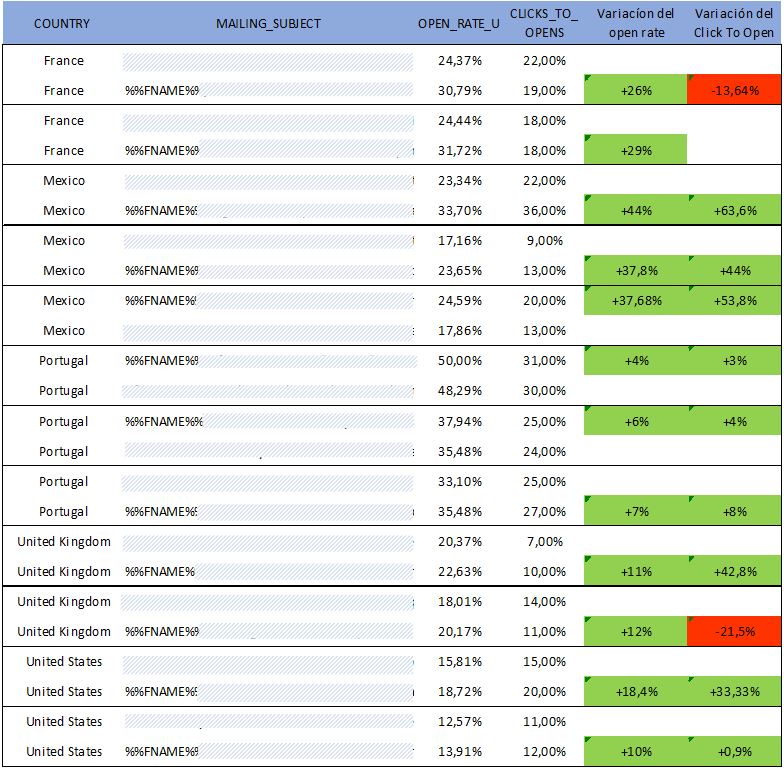
In the following table we have summarized the results of this series of tests that we have recently carried out.
We see how the fact of personalizing the subject translates into an increase in opens in all markets. On the other hand, it is striking that In some markets this means increases of up to 44% (Mexico), while in others it remains at +6% or 7% (Portugal).
As for the incidence of personalization in the click to open ratio (the ratio of unique clickers/unique openers), its positive effect is also evident.
It is worth noting that different tests in the same market have yielded very similar results. For example, in France, the two tests show an increase in open rate around 27%. In Mexico, the three tests show an increase in open rate around 40% in all three cases, while in Portugal it is around 6%-7% and in the UK around 11%-12%. It is evident that personalization in the subject line has more pronounced effects in some markets than in others (specifically in Mexico).. From the point of view of click to open, we find the same reality.
Beyond confirming once again the importance of maintaining a direct and personal tone in communications with our user database, the exercise we have discussed in this post shows us the differences that exist in the ways we communicate depending on the society in which we find ourselves: In Mexico, direct and personal communication has a much more positive effect than, for example, in Portugal.. However, are these data sufficient to give solid validity to this claim? We believe that they are not. To do so, we would have to repeat this type of comparison in a more regular manner and over a larger temporal window. It does serve, however, as a starting point and stimulus for this next analysis.
