
Keys to the reputation of the sender in email marketing: Private or Shared IP
Deliverability is one of the critical aspects of email marketing and often one of the most unknown. factors influence whether an email reaches the inbox or ends up in the spam folder. We have discussed them on other occasions. Today we focus on a key factor: the sender's reputation.

Email clients put obstacles in the way of those Unknown senders or with a history of suspicious activity. The reputation will be associated with a subdomain from which we send the emails and with the IP from which they are launched. We can always control the good reputation of the subdomain from which we send, by controlling the quality of the databases to which we send, as well as applying good practices to the message configuration (valid HTML, slow sending speed, subject without suspicious words…). However, it is more difficult to understand how the sending IPs work. If we have enough sending volume, we can access a private IP and thus be the only ones responsible for its reputation, applying the good practices we talk about so much on this blog. This would be the ideal situation: a subdomain and an exclusive sending IP for one account. In this case, to build a good reputation we must understand that a heating process It lasts several weeks. During this period, we must be especially careful with the sending of emails to obtain good open and click rates and a low bounce rate. It is recommended, in these initial emails, to launch BBDD with active users with whom we will obtain better data. Once the subdomain and IP are warmed up, we can relax the alert level and send emails normally, but always paying attention to the factors that influence reputation; in short, fulfilling the requirements demanded by email clients, and as we said, Good practices in email marketing.
However, sometimes we do not have a private IP for a single account; rather, due to various factors (low sending frequency, low volume, resource scarcity, or time constraints…) we must work with Shared IPs. In this case, we have less control over deliverability. We must always continue to apply good practices that will affect the reputation of our subdomain, but there are external factors that affect the IP from which shipments are made. Other companies are using these IPs and their activity influences the overall reputation of those IPs. Generally, the various shipping platforms avoid SPAMMERS and control that their customers who use shared IPs follow rules that allow maintaining overall good reputation. Each platform applies a series of different rules to prevent damage to their own reputation. pools IP addresses. However, despite the platform's efforts, some customers may occasionally bypass these rules and send them in very large and uncontrolled quantities, causing damage to these IP addresses and tarnishing the reputation of other companies that do take care of the quality of their mailings and send mailings from the same source. When this happens, the platforms initiate the necessary processes to restore the reputation, but these processes often take weeks to take effect.
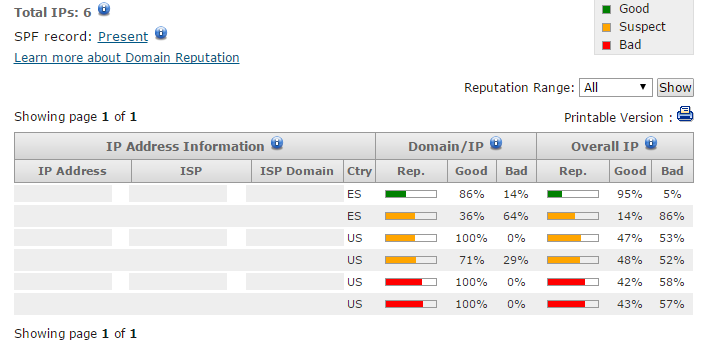
It is advisable to use a private IP whenever possible, so that reputation depends solely on our own activity. In the case of using shared IPs, we must check your health periodically of these with tools like borderware.com o senderscore.org. If we detect incidents in our shipments (lower opening rate compared to usual data) or alerts in these tools, such as in the capture below, we must immediately report it to the platform so that it takes the necessary measures to resolve the IP issues.
It is also practical Having an account on another platform of shipments, so that in the event that we encounter this type of problem, we can have an alternative to send our emails without experiencing serious delivery problems.
