
Copywriting in email marketing

On other occasions we have discussed how the design of emails affects the results of email marketing, but today we will talk about the use of language in our messages, which is equally important.
As often happens in design, many companies seek to fleeing an excessively commercial appearance, Because we understand that if the commercial intent is clear, we will repel a user who is saturated with advertising messages. However, what repels the user is not the commercial aspect or tone of a message, but its content. a message that does not align with your needs and interests. Let’s imagine two scenarios to understand this: we receive two emails, one in a «letter» format presenting a product that we have never used, nor is it related to our daily life or our usual consumption, and another in a «catalog» format with discounted products from a brand we have previously purchased. Although the appearance and copy of the second may be much more commercial, we are much more interested in it and its effectiveness will be greater, so we again appeal to relevance as the main driving force for sales. Thus, although at first we tend to avoid sales language, it is not always necessary, or even advisable. A Direct and commercial message, The «buy now» type of email can work, although it is true that if we do not fine-tune the targeting to the audience, this type of message will generate rejection among those audiences that are not interested in our offer.
The tone and language used will depend on factors such as the following:
- IssuerIs it a person or a corporate broadcaster? The tone of the language should be consistent with the brand's branding (young and fun, serious and elegant…).
- Intentionality From the message: Do we want to sell, introduce a new product, retain customers, or ask for more data? We can use a more aggressive language aimed at boosting sales, or conversely a calm and customer-focused language to gain their trust and achieve their loyalty.
- Type of publicJust as the tone of the message is influenced by the character of the sender, so too the character of the receiver must be taken into account; therefore, we will not speak the same way to a student, a retiree, a parent, or the director of a bank.
- Reasonable/impulsive buying. If it is a product that is purchased impulsively, we will opt for a direct language, without going into too many details, and we will often seek to communicate more through emotion; whereas if it is a product or service that requires a deep analysis by the customer (as happens, for example, when buying a car, a computer or a house), we will choose a more descriptive and comprehensive text.
Some tips for adjusting the copies of the emails:
- It attracts attention: Some copies can arouse the user's curiosity and lead them to open or click on them. If you're not sure what might work, don't do it!Test!
- Keep the interest: Read your texts and review the structure. Don't let the user get bored.
- It is clear and avoids redundancy: Don't keep unnecessary information or accumulate too much data in dense texts. Be clear, direct, and connect with what the user wants.
- Apply creativity. Like here:
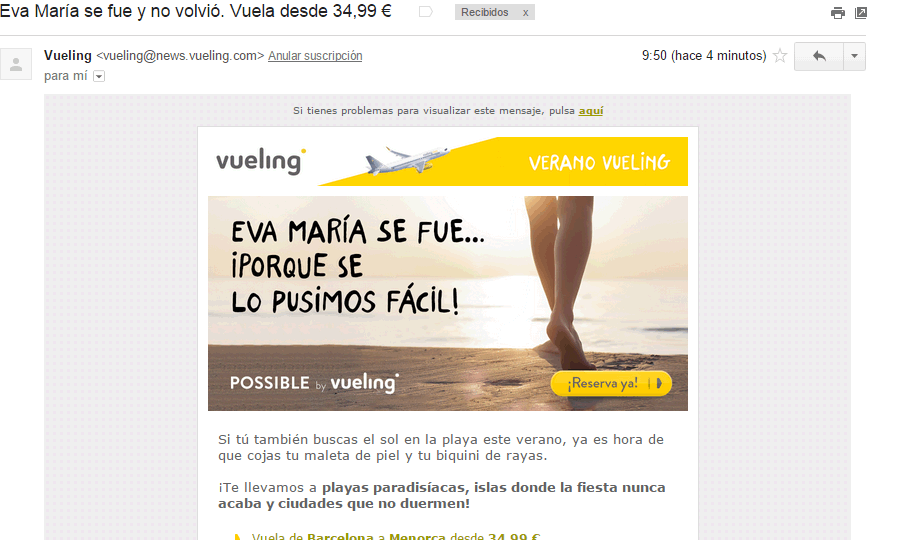
Or like here ;):
- Shakira is not wrong:
«I always knew that it is better, when it comes to talking about two people, to start with oneself».
Says the singer. Well, that's not going to happen.
 Imagine receiving an email from a company that wants you to hire their services. They tell you all about them, talking about how awesome they are and how well they do their job. All the awards they have won. All the clients they have worked with, but they do it in a generic way, without personalizing it, without talking about your needs and why they can help you. When you have to talk about two people, the best thing to do is start with the client. Addressing them by name, focusing on their interests and needs, approaching their perspective, and basing the discourse on how we will improve their current situation.
Do you have any other ideas to improve the texts of your emails? Have you had any interesting experiences with the use of language in email marketing?
