
Email Marketing as a Relationship Marketing tool
Leaving aside the economic metrics, whose nature deserves a separate treatment, in Digital Response we usually analyse the performance of Email Marketing campaigns based on the Open Rate and the Click To Open Rate. For those of you who are not familiar with these metrics, here is their description:
- Openers: Unique users who have opened at least one email in a campaign.
The five factors that directly influence the opening behavior of an email are: the from (the identity of the sender), the subject, the time of sending (day and time), the previous experience the user has had with other emails received from the brand and finally the deliverability. A poor open rate can be improved if it is identified which or which factors these results are influenced by and optimized accordingly. - Clickers: Unique users who have made at least one click after opening an email in a campaign. The three key factors that influence the click ratio are the offer, the relevance of the content compared to the user's expectations, and the number of clickable links.
- Click To Open (reactivity): clickers for every 100 openers.
Reactivity is a metric that indicates the degree of interest in the content among our audience. We have analyzed the annual evolution of the databases of a company in the Tourism sector and another in the Retail sector from the perspective of Open Rate and Click To Open. The two databases share similarities: the main source of data acquisition has been offline (Hotels in one case and stores on the street in the other). On the other hand, in both cases no online acquisition action has been carried out, meaning that the online registrations have occurred organically (registration on the site and the e-commerce).
Open Rate
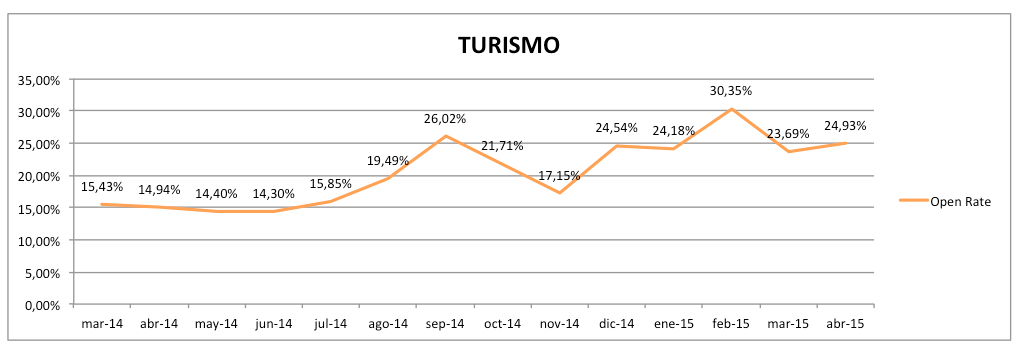
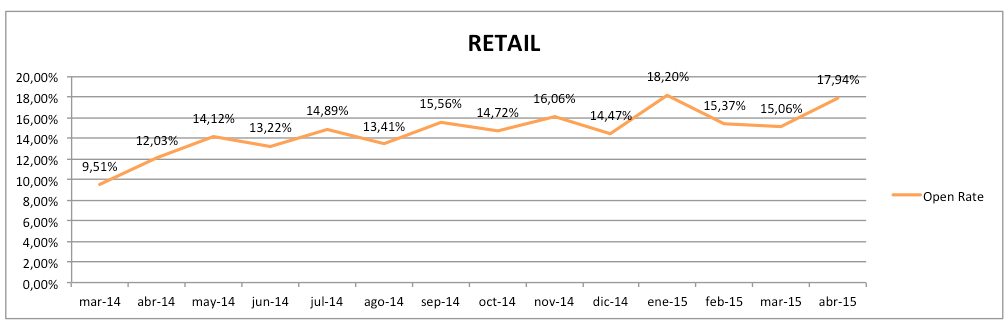
In both cases, there is a rising trend in the open rate in both databases. In the case of the Tourism company, the increase in the open rate over the last twelve months has been 60%. In the retailer, the increase was 30%.. One important factor in the increase in open rates is the specific actions taken throughout the year, such as the implementation of AB testing of emails and other matters, the improvement of deliverability, or the cleaning of the database. A very relevant aspect is that despite having significantly increased the number of monthly shipments throughout the year, users continue to show interest in discovering what content brands have to offer them. In this post we talk about the relationship between shipping volumes, low volumes, and revenue per email.
Click To Open
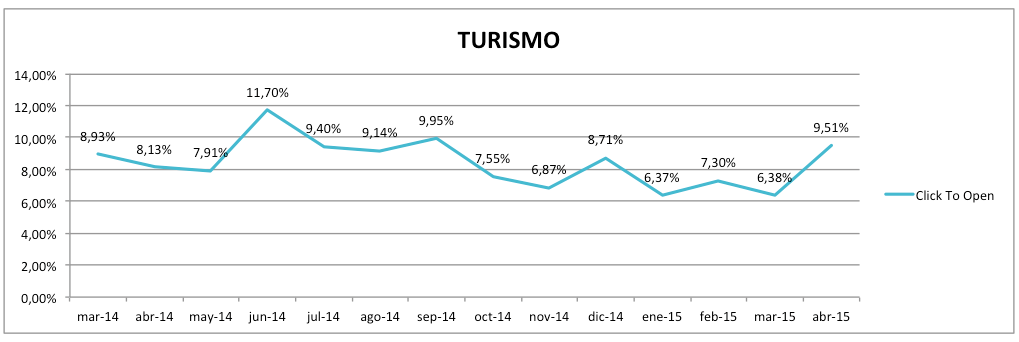
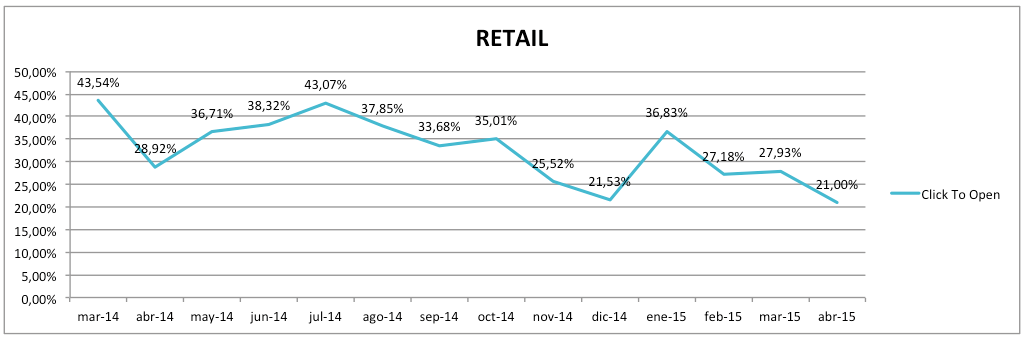
In the case of Click To Open, we see that the trend is the opposite. In the tourism company it has decreased by 40%, while in retail it has decreased by 23%. Unlike the improvement in open rate, improving click-to-open is more difficult to achieve. The two main resistance we encounter in the agency when implementing changes to improve click-to-open are:
- Restrictions from a branding perspective. For example, respect for the brand positioning is often prioritized at the expense of other more commercial aspects (discounts, call-to-actions).
- An excessive focus on the product. We have found that many companies, despite having CRM departments and striving to carry out truly relational marketing (link), still operate under a Product/market paradigm. In this context, email marketing is seen as an effective channel for communicating product news to the entire database, rather than as a tool for relationship marketing which allows each group of users to be informed of the content that will best meet their needs.
At Digital Response we believe that branding restrictions can, in most cases, be justified, so we want email marketing professionals to find ways to create more agile email marketing that respects the brand image (a paradigmatic case in this regard would be the responsive email designRegarding the second major resistance, the excessive focus on the product, it is key to be pedagogical and to justify with numbers and data the benefits that a truly relational approach between the company and its customers brings.
