
Email Marketing for subscription-based business models
We want to present in a general way strategies for Email Marketing that we can apply to subscription-based business models.
A subscription-based business model is one that, instead of closing each sale to market a product or service, what is marketed is access to the product or service at a certain frequency. (monthly, annual, customized) .
Some examples of this type of business models can be:
- Newspapers and magazines
- Telephone Companies and Internet Providers
- Hosting
- Financial products
- Associations or Clubs
- Software
- Access to paid websites
- Tourist stay vouchers
- Insurance
- Etc...
EMAIL MARKETING PROGRAMS IN SUBSCRIPTION BUSINESS MODELS
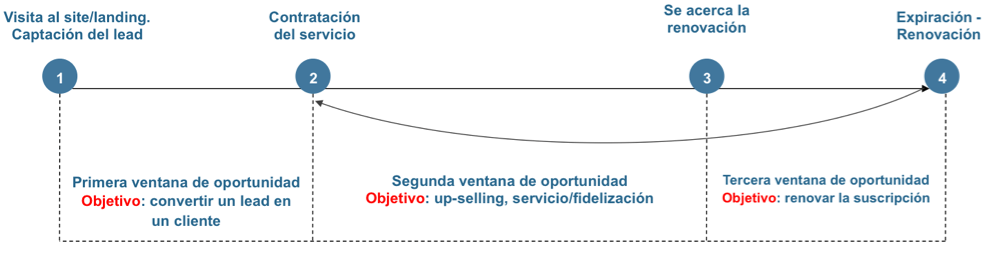
When creating an email marketing program for these types of models, it is essential to establish, first of all, what the target audience will be. User Lifecycle as well as the paths that will be traversed along the same path (journey). Without going into the specifics of each business model, and being very synthetic, a user's life cycle could be represented with the following scheme:

The user initiates a search, usually online, finds a candidate to provide the service, and requests information. (1). After a period of «evaluation» and if we have done things well, the user will contract the service. (2). As we continue to provide the service, the time for renewal will be closer. Therefore, it makes sense to establish a time of anticipation. (3) on the date of expiration or renewal (4).
We are going to add to this scheme what we call «windows of opportunity«These are the ones... «moments of truth» in which the user is more predisposed to «convert» and depending on the marketing messages. The 3 major windows of opportunity correspond to the moments when:
- The user is more likely to contract the service
- The user is more likely to «engage» with the brand
- The user is more likely to renew or unsubscribe from the service.
1. First window of opportunityThe user has a greater propensity to contract the service. The moment a user visits our site and leaves their data, a process of decreasing «engagement» begins. In other words, as time goes by, the chances of that user converting decrease (see the notion of recency). Since the user is at the best moment in the life cycle to convert (they are actively searching for our service!), we must maximize the opportunities to impact them with conversion-oriented marketing messages. To do this, we propose the following tactics.
1.a. Resending. It will be a matter of giving elasticity to email marketing campaigns that we have in this stadium (whether it be a welcome email, an email with the results of a price comparison, an offer to hire the service for free for a certain period of time or any type of email that is executed at this stage of the life cycle), so that We maximize the options to impact users.

In this post https://www.digitalresponse.es/blog/ejemplo-de-email-marketing-que-sucede-cuando-reenviamos-un-email-a-no-abridores/ We present the results of this type of actions in the specific case of referral to non-openers.
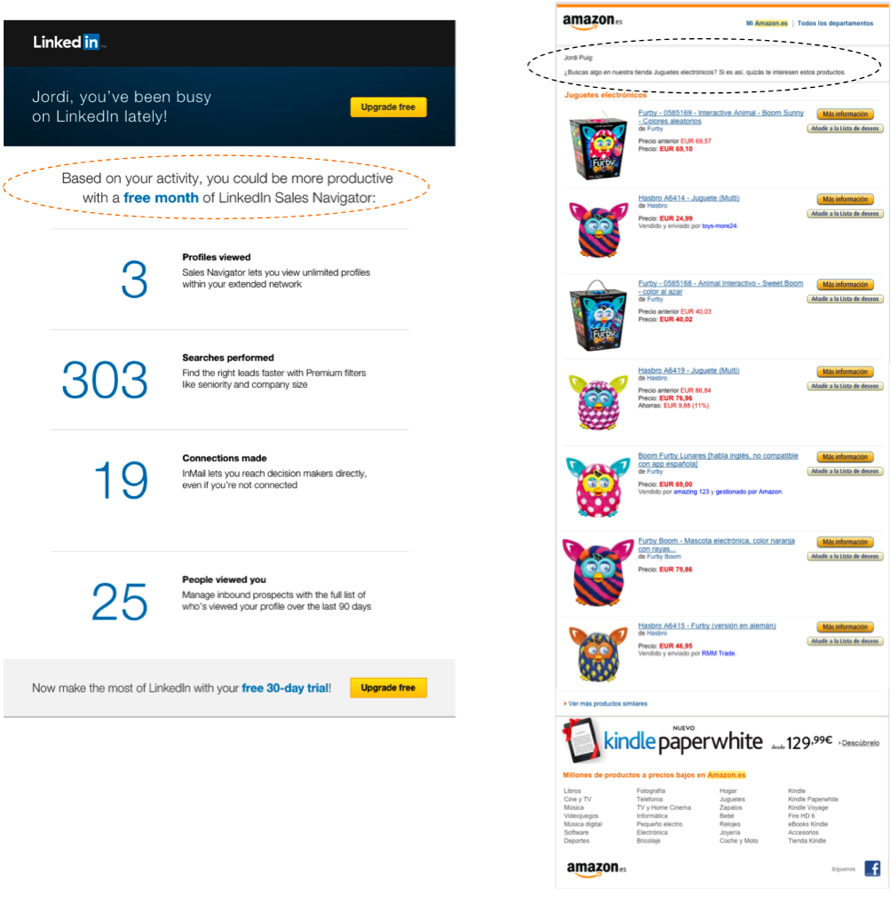
1.b. Browsing Behavior (behavioral segmentation). It consists of sending an email with the content visited by the user during a session on the site. In the first opportunity window, a user can access the site repeatedly; at first, they may register and, at later times, they may access it again to obtain more information. A very effective tactic in these situations is to send a «trigger email» to the user with the content they have visited on the site.. It is about maintaining commercial pressure with content that, in the vital context of the user's purchase, is considered relevant (we have stopped them from consuming it on the site). In this type of emails it is important to keep in mind that what we are going to do is bring the website to the user's email inbox.
2. Second window of opportunity: the user is more likely to «engage» with the brand. Once we have captured a customer, we will have to offer them the contracted service over a certain period of time. While the type of messaging we provide at this stage will be determined by the type of service we provide (alerts, product updates, extract information, etc.), It is important to keep in mind the general attitude of the user towards our brand. First of all, they have already experienced the service, and second, if they are satisfied, they will be more receptive to evaluating proposals that improve or expand the same.. On the other hand, since we already have the customer captured, the type of communication should be less «aggressive» and more focused on service and positioning the brand (if we achieve this, it will be easier for the user to renew when the time comes).
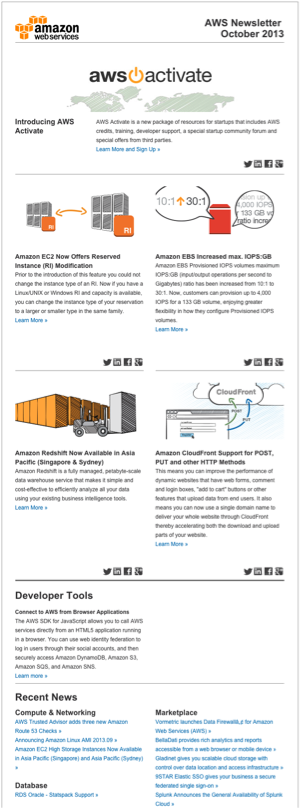
A very valid alternative consists of developing newsletter with editorial content. It is about sending valuable content to the user (related to the business theme in which we operate). If we do it well, this will generate two great benefits. First, it will help us position the brand, and second, we will create awareness. It is key at this point to be relevant regarding the content we are going to send to our users. In this sense, creating sociodemographic or behavioral profiles that will help us achieve this.
3. Third window of opportunity: the user is more likely to renew or unsubscribe from the service. When the subscription expiration time arrives, two things can happen: either the user unsubscribes or they renew the subscription. (In some cases, renewal can include an increase or decrease in the level of service). It is clear that the experience with the service and the value perceived by the user will determine the outcome. In any case, we are in a context where the opportunity for the brand consists in maximizing the number of renewals and their value. A good tactic to approach this moment is to «anticipate» the arrival of the «moment of truth» that comes with renewal.. Thus, we can carry out a series of reminders 90, 60, 30, 15, 7 and 1 day before the service expiration date.

These reminders can be used for different purposes depending on the distance to D-Day: measuring the level of user satisfaction (90 days), (reminding them that they can upgrade the service (60 days), giving them access to the catalog of services/products that they can re-subscribe to (30 days), simply reminding them that they have 15 days to renew, urging them to renew (15 and 7 days). The approach will depend in any case on the type of business and how the marketing department handles communication and positioning.
