
What is Kinetic Email and how can it help us?
This post will be dedicated to talk about Kinetic Email, a very interesting trend that we will be seeing throughout 2018 and that allows us to make our emails much more interactive. We will also classify the 3 types of Kinetic Email that exist and we will see what role they play today.
When we talk about Kinetic email we are referring to that type of email that It allows customers to have a more immersive brand experience, something they don't get from typical generic and repetitive emails. Therefore, we could say that It has the function of Make emails more visual and offer a user experience more similar to that of a website, By presenting thus, a new layer of interactivity to the email marketing experience.
As far as typologies are concerned, we can find or distinguish 3 categories that are created thanks to the different interactive and dynamic designs that are fully implemented in HTML and CSS:
Kinetic Email
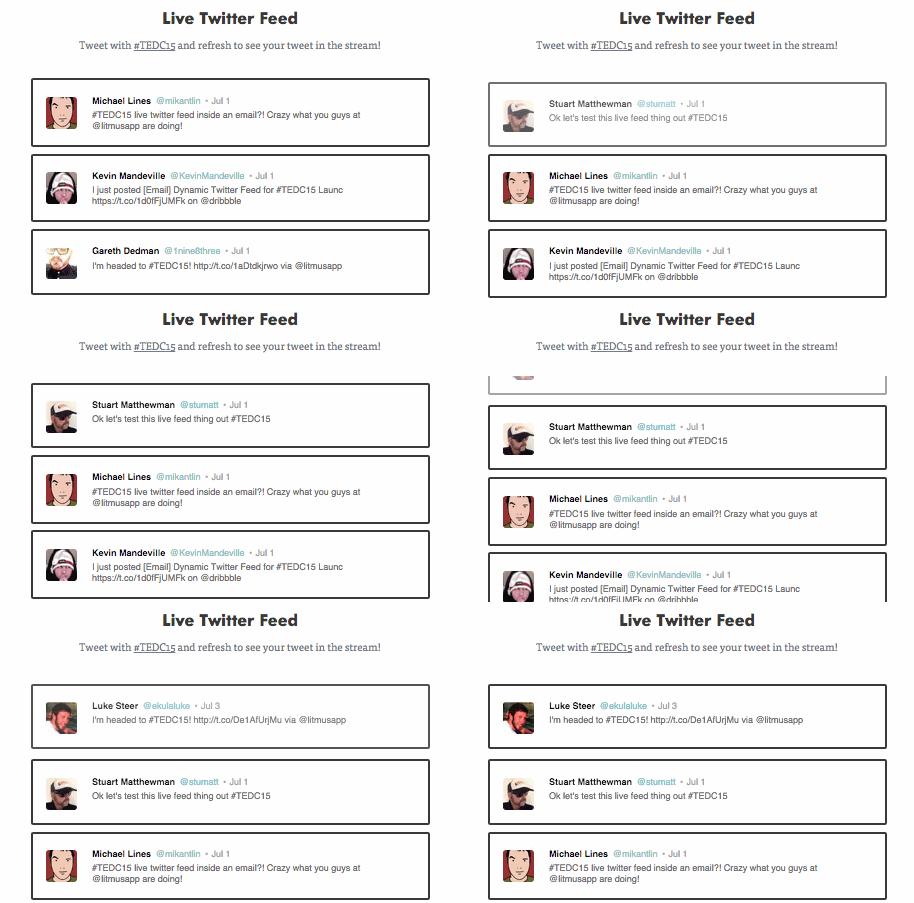
The Kinetic Email simply uses CSS transitions and animations to display key campaign content. An example would be an automatic slide carousel where each slide displays different content or, as you can see below, implement the Twitter activity in CSS in real time.
Interactive Kinetic Email
This type of email adds elements that allow the user to respond and take action. For example, carousels containing navigation buttons, collapsible menus, or other interactive elements. Interactive, kinetic emails typically involve the use of CSS selectors such as :hover, :active, :focus, or :checked. Below you can see an example:

Email with kinetic effects
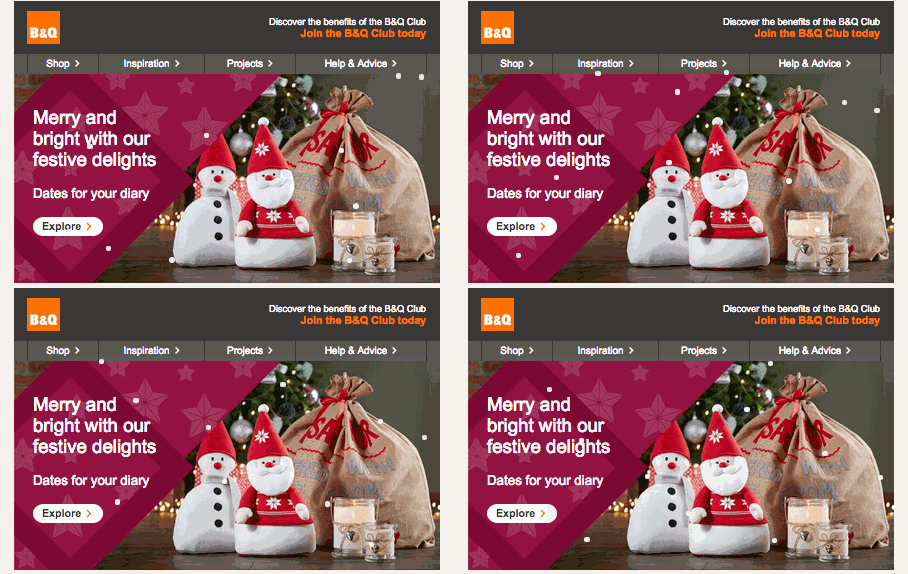
We are talking about «kinetic effects» When CSS animations and interactivity are primarily used to make the content more attractive. For example, to highlight an element when you move the cursor over the screen, to create effects like the one you are seeing below (snow moving), or other effects to attract the subscriber's attention.
Currently, the best examples of Kinetic Email include pop-up buttons, interactive areas, carts for adding orders, image galleries, and other features. As we mentioned earlier, these types of emails are not only more attractive than the typical emails we are used to receiving, but they are also much more effective in encouraging subscribers to interact with the brand and its products. But the question is, if everything is advantages, why haven’t all companies implemented it in their email marketing strategy yet? Although some brands use it, there are still many problems that arise. After all, eThe main problem is that not all existing kinetic techniques work well on all the different technological platforms that exist.
To give you an idea, of every 100 subscribers, only a maximum of 40% could currently view kinetic emails on their devices. This is due to incompatibility issues with different email clients and, almost inevitably, differences between Android/iOS. Moreover, within this 40%, 60% of the devices would be ready to employ an «interactive» functionality and 40% would be ready to employ a «clickable» functionality (largely due to the fact that iPhones are better at representing interactive functions).
Ultimately, until these problems are resolved, the most realistic solution if kinetic techniques are to be used in an email is to also create default versions that are not Kinetic to ensure that all subscribers can view the email.
