
Responsive Email Design: Compatibility across email services
The Responsive Design The web has matured a lot in terms of technology and techniques have been developed to make the most of it while minimizing incompatibilities between browsers. In the case of email, responsive design is a relatively new concept, and for that reason, it is very difficult for us to find success stories and examples that serve as a reference. From a theoretical perspective, we understand that this is the best way to reach all our audiences with minimal effort, but in reality we encounter many obstacles. Obstacles to implementing it. At first, it might seem to us that the compatibility of the media queries With email clients, it's not too worrying. It seems that the only one that can cause more problems is Gmail, since it doesn't read what is declared between the style tags.
In the case of the website, incompatibilities were easier to overcome, but when it comes to designing emails, the difficulty is greater.. On the web, if a browser doesn’t know how to interpret the rules for responsive adaptation, it can display the non-responsive version without any problems and there’s no drama. However, when formatting emails, the interaction between the online styles and what we declare between the tags It usually causes a lot of problems and it’s not easy for “the worst case scenario” to work quite well. A poorly interpreted responsive design usually results in serious structural and design flaws (unless it’s extremely simple).
Therefore, to this day, at Digital Response we believe that the most effective solution for mobile users is fluid design (percentages) which involves much less work and is accepted by all email clients. However, we believe it is necessary to delve deeper into the topic of Responsive Email Design, because it is presented as the best option for the future, which will likely spread and being accepted by more email clients, eliminating many of the difficulties we encounter today.
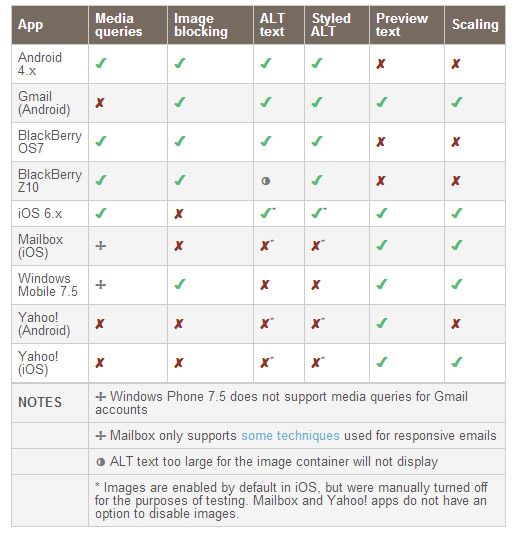
Source: Litmus Blog, July 8, 2013. Mobile Email Compatibility Guide: What Works Where?
In any case, to this day, It is difficult for responsive design to be the ideal solution for our campaigns. This is only the case where we can demonstrate that Our audience mostly uses compatible devices. However, in most cases, we still encounter a variety of devices and the rules to apply for mobile adaptation on different devices and applications often interfere with each other, causing more than one headache. What is your experience? Have you achieved adaptive design by overcoming the obstacles that arise?
To learn more about adaptation of Email on mobilel, download ours ebook.
